ADAS Calibration in Irving, TX
Advanced Driver Assistance Systems (ADAS) calibration for forward-facing cameras, radar, and sensors. Required after windshield replacement on most modern vehicles to keep lane-keeping, automatic braking, and adaptive cruise control functioning correctly.
$200–$600 depending on vehicle
Get My Quote
Six fields, 30 seconds. We'll call you back with a quote.
Signs You Need This Service
- ADAS warning light on the dash
- Lane-keeping drift after glass replacement
- Automatic braking triggers unexpectedly
- Adaptive cruise distance feels wrong
- Newly replaced windshield on an ADAS vehicle
What ADAS Is
ADAS is the suite of safety systems that use cameras, radar, and sensors to monitor the road and assist the driver. These include Forward Collision Warning, Automatic Emergency Braking, Lane Departure Warning, Lane Keeping Assist, Adaptive Cruise Control, Traffic Sign Recognition, and Blind Spot Monitoring. The forward-facing camera is typically mounted behind the windshield, which is why windshield replacement affects these systems.
Why Calibration Is Required After Glass Replacement
When a windshield is replaced, the camera's mounting position can shift by a fraction of a degree. To a human that is invisible; to the camera it changes where the system thinks the lane lines and the vehicle ahead are. Without recalibration, your lane-keeping system may nudge you off-center, your automatic braking may trigger late or early, and your adaptive cruise may misjudge following distance. Manufacturers require calibration after any windshield replacement on ADAS-equipped vehicles.
Static vs Dynamic Calibration
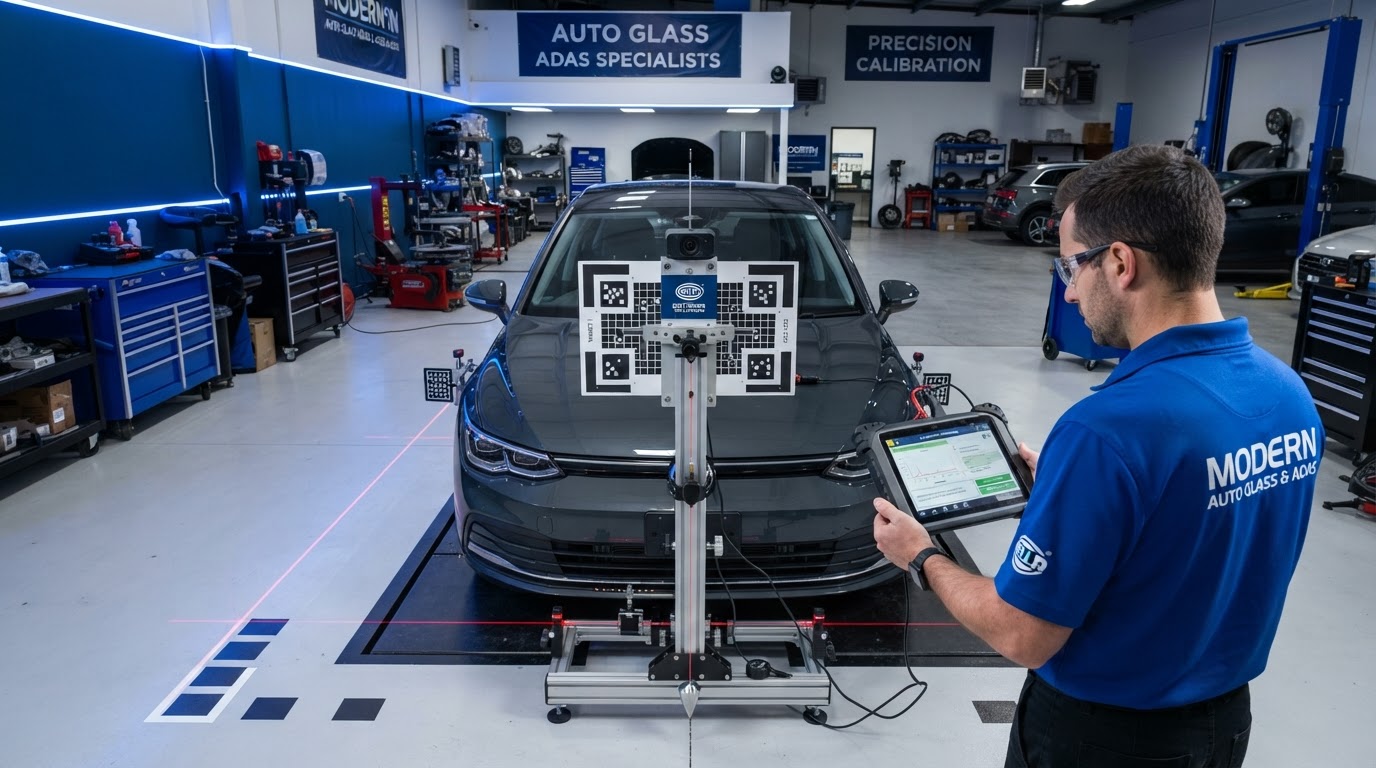
Static calibration is performed in the shop using printed targets placed at precise distances and angles around the vehicle while the camera is put into calibration mode with a scan tool. Dynamic calibration is performed on a calibrated test drive at a steady speed on a marked road. Many vehicles require both — static first to set the baseline, then dynamic to fine-tune under real driving conditions.
The Calibration Process
We set tire pressure to spec, verify vehicle ride height, place the calibration targets at the exact distance and height for your vehicle, connect the scan tool, and run the manufacturer calibration routine. The system reports pass/fail; if it fails, we adjust the camera and re-run until it passes. We print the calibration report for your records and the vehicle's service history.
Safety Risks of Skipping Calibration
An uncalibrated ADAS system may not warn you in time, may brake unexpectedly, or may fail to brake when needed. Studies by AAA and the IIHS show that even a small camera misalignment can significantly delay or disable automatic emergency braking. Skipping calibration is not worth the risk — and it can shift liability in the event of a collision.
OEM Glass and ADAS
Forward-facing cameras rely on the optical clarity and transmittance of the glass in front of them. OEM windshields include the camera bracket and the correct optical coating. Aftermarket glass may have a slightly different tint or thickness that causes calibration to fail or the system to behave inconsistently. For ADAS-equipped vehicles we strongly recommend OEM glass.
Cost and Insurance
Calibration typically adds $200–$600 to a windshield replacement depending on the vehicle and whether static and dynamic calibration are required. When the glass replacement is insurance-covered, calibration is usually included in the claim. We document the calibration and submit it with the claim.
Forward Collision Warning and Automatic Emergency Braking
Forward Collision Warning (FCW) monitors the distance to the vehicle ahead and alerts you if you are approaching too quickly. Automatic Emergency Braking (AEB) goes a step further — it can apply the brakes automatically if it detects an imminent collision and the driver does not respond. Both systems depend on a forward-facing camera mounted behind the windshield, and some vehicles add radar sensors in the front grille or bumper. After a windshield replacement, the camera's view angle can shift by fractions of a degree — enough to change where the system thinks the vehicle ahead is. A misaligned AEB system may brake too late to prevent a collision, or it may brake unexpectedly when there is no obstacle, creating a rear-end collision risk. This is why manufacturers mandate recalibration after any windshield replacement on vehicles equipped with these systems. We calibrate FCW and AEB to the exact specifications published by the vehicle manufacturer, using OEM scan tool protocols and precision-placed calibration targets.
Lane Departure Warning and Lane Keeping Assist
Lane Departure Warning (LDW) alerts you when your vehicle drifts out of its lane without a turn signal. Lane Keeping Assist (LKA) goes further — it can apply steering input to keep the vehicle centered in the lane. Both systems use the forward-facing camera to read lane markings on the road surface. After a windshield replacement, if the camera is even slightly misaligned, the system may think you are drifting when you are centered, or it may fail to detect that you are leaving the lane. On Texas highways like I-35E and the President George Bush Turnpike, where lane markings can be faded or construction zones shift lane boundaries, a properly calibrated system is critical. We calibrate LDW and LKA using manufacturer-specific target patterns and scan tool routines, and we verify the system responds correctly to lane markings during a dynamic calibration test drive.
Adaptive Cruise Control and Traffic Sign Recognition
Adaptive Cruise Control (ACC) maintains a set following distance from the vehicle ahead, adjusting your speed automatically as traffic slows and speeds. Some ACC systems use radar; others use the forward-facing camera; many use both. Traffic Sign Recognition (TSR) reads speed limit and other traffic signs and displays them on the instrument panel or head-up display. Both systems depend on the forward-facing camera's precise alignment. After a windshield replacement, a misaligned camera can cause ACC to maintain too much or too little following distance, or it can cause TSR to misread or miss signs entirely. We calibrate ACC and TSR to manufacturer specifications, and we verify correct operation during the dynamic calibration test drive. For radar-based ACC, we also check the radar sensor alignment behind the front bumper or grille.
Static Calibration: Precision in the Shop
Static calibration is performed in a controlled shop environment because it requires precise placement of calibration targets at specific distances, heights, and angles relative to the vehicle. The targets are large printed patterns — typically checkerboards, concentric circles, or vehicle-specific patterns — that the camera recognizes during the calibration routine. We measure the distance from the vehicle's centerline to each target, verify the vehicle's ride height and tire pressure (which affect the camera's viewing angle), and use a scan tool to put the camera into calibration mode. The scan tool communicates with the vehicle's computer and runs the manufacturer's calibration algorithm, which compares what the camera sees to what it should see and adjusts the internal parameters. The system reports pass or fail; if it fails, we adjust the camera's physical mounting and re-run the routine until it passes. Static calibration is the foundation of ADAS recalibration, and it cannot be done properly without the correct targets, the correct distances, and a level surface.
Dynamic Calibration: Real-World Verification
Dynamic calibration is performed on the road — a calibrated test drive at a steady speed on a straight, well-marked road with clear lane lines. During the drive, the camera observes real-world lane markings and vehicle positions, and the system fine-tunes its internal parameters based on what it sees. Dynamic calibration is required by some manufacturers in addition to static calibration, and by a few manufacturers instead of static calibration. We perform dynamic calibration on a verified test route near our Irving shop that has consistent lane markings, clear sightlines, and minimal traffic. The drive takes 20 to 30 minutes at a steady speed, and the scan tool monitors the calibration status in real time. If the system cannot achieve calibration during the drive — due to faded lane markings, heavy traffic, or other interference — we reschedule for better conditions. We never pass a vehicle that has not been fully and properly calibrated.
Why We Recommend OEM Glass for ADAS Vehicles
The forward-facing camera looks through the windshield, and the optical properties of that glass matter. OEM windshields are manufactured to the exact optical transmittance, tint, and thickness specifications that the vehicle manufacturer calibrated the camera to at the factory. They include the camera mounting bracket in the exact position, and they may include special optical coatings or a camera window area with different transmittance than the rest of the glass. Aftermarket (OEE) glass meets federal safety standards for impact resistance, but it may have slightly different optical properties. In many cases, OEE glass calibrates fine. But in some cases — particularly with luxury vehicles, vehicles with head-up displays, and vehicles with the latest generation of ADAS — aftermarket glass can cause calibration to fail or the system to behave inconsistently after calibration. The risk is not worth the savings. For any ADAS-equipped vehicle, we strongly recommend OEM glass, and we will tell you if your vehicle specifically requires it.
The Dangers of Driving with an Uncalibrated ADAS System
If you replace your windshield and skip calibration, your safety systems may appear to work normally — the warning lights may be off, the systems may respond in normal driving — but they can fail at the critical moment. AEB may brake 20 feet too late. Lane keeping may drift you toward the edge of the lane. ACC may follow too closely. The system may also generate false alerts, braking unexpectedly when there is no obstacle, or beeping when you are centered in the lane. These false alerts are not just annoying — they can cause a startled driver to swerve or brake in traffic. Research by AAA and the Insurance Institute for Highway Safety (IIHS) has shown that even a small camera misalignment can significantly delay or disable automatic emergency braking. Beyond the safety risk, driving with an uncalibrated ADAS system can shift liability in the event of a collision — if your vehicle's safety systems were not properly calibrated after a known glass replacement, that fact can be used against you. Calibration is not optional; it is a safety requirement.
What a Calibration Report Includes
Every ADAS calibration we perform is documented with a printed report that includes the vehicle identification number (VIN), the date of calibration, the technician's name, the scan tool software version, the calibration method used (static, dynamic, or both), the target placement measurements, and the pass/fail result for each system calibrated. This report goes into your vehicle's service history and is provided to you for your records. If your vehicle is leased, the calibration report documents that the safety systems were properly restored after glass replacement — which is important for lease return. If you are filing an insurance claim, the calibration report is submitted with the claim documentation. And if you ever sell the vehicle, the calibration report provides proof that the ADAS systems were properly maintained. We maintain electronic copies of all calibration reports and can provide duplicates on request.
Scheduling ADAS Calibration in Irving
If your vehicle has had a windshield replacement — by us or by another shop — and the ADAS systems have not been calibrated, call us immediately. We perform standalone ADAS calibration at our Irving shop, using manufacturer-approved targets and scan tool protocols. The process takes 1 to 2 hours depending on the vehicle and the calibration type required. If you are scheduling a windshield replacement with us, calibration is included in the service for all ADAS-equipped vehicles — we will not hand you back a vehicle with uncalibrated safety systems. If another shop replaced your windshield and skipped calibration, we can help. Bring us the vehicle, and we will calibrate the systems and provide the documentation you need. Call (972) 579-7400 to schedule ADAS calibration in Irving today.
Expert Advice
Address auto glass damage early. A small chip or crack can spread rapidly under Texas temperature swings and road vibration, turning a simple repair into a full replacement. Call us at (972) 579-7400 for same-day service across Irving and the DFW metroplex.
Reviews
Our customers leave honest reviews on our Google Business Profile. We do not publish invented testimonials on this site.
ADAS Calibration — Frequently Asked Questions
Answers to the most common questions about this service from Irving and DFW drivers.
Is ADAS calibration always required after a windshield replacement?
How long does calibration take?
Does insurance cover calibration?
Can you calibrate all vehicle brands?
What happens if I skip calibration?
Can you calibrate my vehicle if another shop replaced the windshield?
Do I need OEM glass for ADAS calibration to succeed?
What is the difference between static and dynamic calibration?
Will I get a calibration report?
Decision Guides
Not sure where to start? These guides help you decide what your vehicle needs.
Explore Other Services
Serving Irving & All of DFW
ADAS Calibration is available at our shop at 1905 E Shady Grove Rd, Irving, TX 75060, or our mobile units come to you anywhere in Irving and across the DFW metroplex.
1905 E Shady Grove Rd, Irving, TX 75060
Get directions →Damaged Glass? Don't Wait.
A small chip can spread into a full crack overnight. Call now for same-day mobile service across Irving and the DFW metroplex — we file the insurance claim and bill the insurer directly, so you pay only your deductible.